AI reverse engineering in Egypt: model the part, then make it here
A part with no drawing? Model it with AI from photos, a scan or a STEP file, yourself or with us, then have it made locally in Egypt.
By BlacksmithAI · · 8 min read · اقرأ بالعربية
Key takeaways
- A part with no drawing or CAD file can be rebuilt as an editable model with AI, from phone photos, an STL scan or a STEP file. You can do it yourself in our tool, which is in private beta, or send us the part and we handle it end to end.
- The AI starts from a part that exists. It does not design a new part from a description; plain words are for refining the model it built.
- After the CAD, metal parts go to our local machining partner, 20 units of a small plastic part to the Production package, and runs of 500 to 2,000 plastic parts to vacuum casting. Anything else is quoted case by case.
- We make parts in Egypt, quote in Egyptian pounds, and work with you in Arabic. Customers in the GCC can be served too.
Perhaps you have one part like that: the supplier has stopped making it, the minimum order is far more than you need, or a replacement takes weeks to arrive. For many such parts, our advice is to stop importing: get the part modelled, then have it made here. Below are the two ways to get the model, where the part is made afterwards, and when another option suits you better.
Two ways to get the CAD: do it yourself, or send us the part
| Do it yourself | Send us the part | |
|---|---|---|
| Who does the modelling | You, with our AI tool | We do, end to end |
| What you start from | Phone photos; an STL scan or a STEP file on request during the beta | The physical part, or the photos and files you have |
| What you end up with | An editable CAD file you export, which is yours | The CAD file we build, handed to you and yours to keep |
| Who you deal with | The tool itself | An account manager, with support in Arabic |
| Price | $24.99 a month for about 10 generations, or $49.99 for about 25, in US dollars (plans) | Quoted per part, by its complexity and what we start from, in Egyptian pounds |
| How to start | Request access first (the tool is in private beta) | Send us the part details |
Model it yourself if the part is on your desk, you have calipers, and you have time to check the dimensions the AI flags. Send it to us if you would rather hand the job over, or if the part has to be made anyway and you want one contact from the model to the finished part.
What the AI builds from your part
This is what AI Reverse Engineering does with a part:
- It reads the part as features. A vision model sees a flange, a socket, bolt holes and fillets, and writes an editable parametric model from them. Every dimension is a live parameter you can change.
- One measurement sets the scale. Photos carry shape and proportion but no size. Give one real measurement, such as a flange length, and every other dimension scales from it. Anything the AI inferred is flagged for your review, so check the dimensions that matter before you manufacture.
- A scan or a file becomes the check. When the model is built from an STL scan or a STEP file, it is compared with that file, and the result says how closely it matches, for example "matches within 0.2 mm". In the tool, STL and STEP upload is turned on by request during the beta.
- Plain words refine it. Describe what is wrong ("the boss is too tall") and the AI revises the model.
- It exports files a workshop can use. Export STEP for SolidWorks, Fusion 360, Onshape or any other CAD package that reads STEP, STL for a printer, or open the part in Fusion 360 as editable features.
The AI works from a part that exists. It does not design a new part from a description; words are for adjusting the model it has already built from your photos or files.
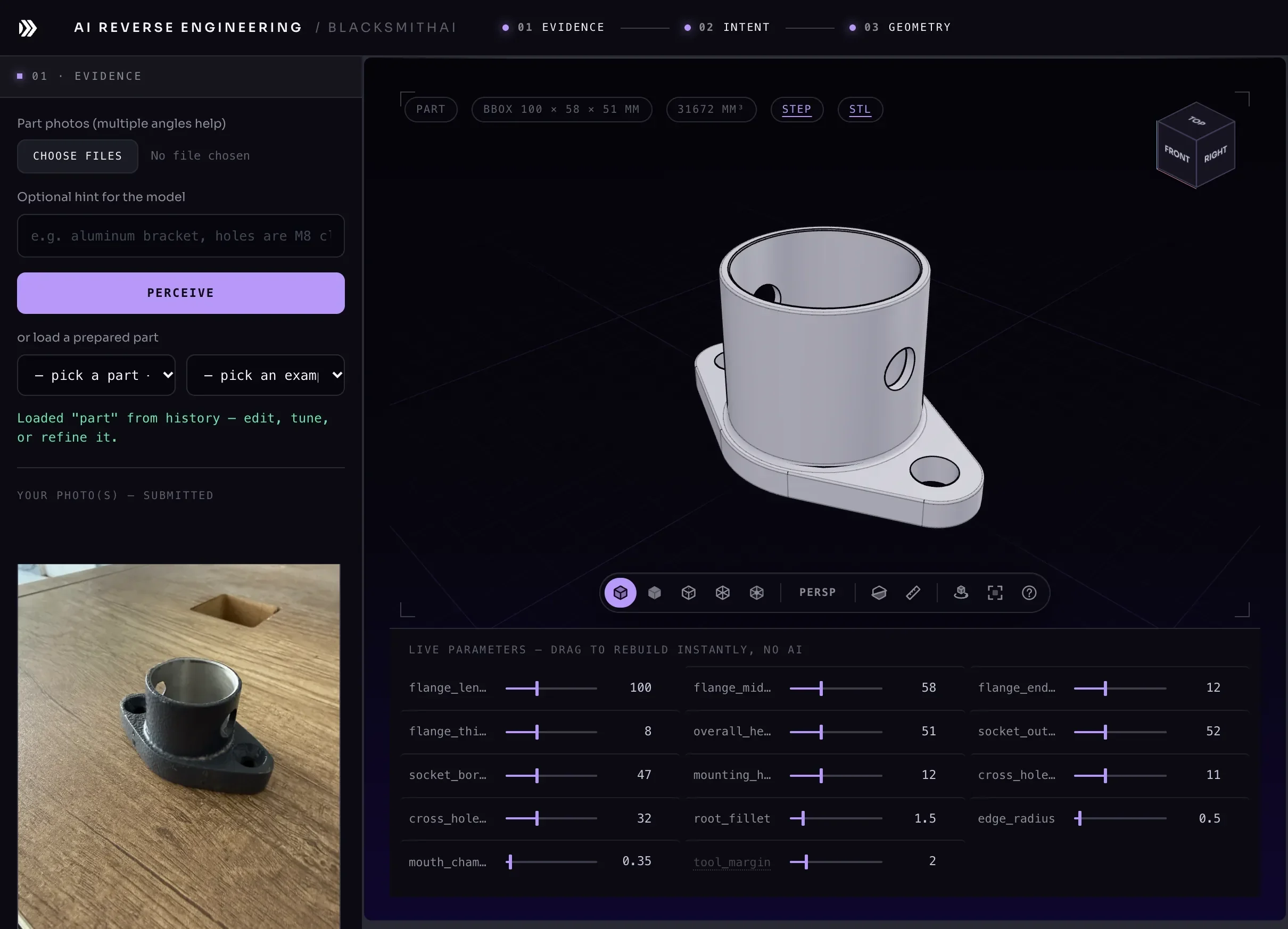
The screenshot is from a real run: one iPhone photo of a cast part, rebuilt as a valid solid with 14 live parameters and exported as a 205 KB STEP file. No measurement was given in that run, so its sizes are proportional. One caliper reading would have set the scale for all of them.
AI reverse engineering in Egypt, step by step
The steps are the same whether you model the part yourself or send it to us. What changes is who does each one.
- Send the part, or what you have of it. If you are modelling it yourself, upload phone photos, or an STL scan or a STEP file once file upload is on for your account (on request during the beta). If we are modelling it, hand over or ship the physical part to us, or send the photos and files you have.
- Set the scale and check the flags. Give one real measurement and review every flagged dimension. If we are modelling the part, we do this step, so tell us which dimensions are critical.
- Approve the model. The part is made to this model, so check it before it goes to production. On the 20-unit package, nothing is made until you approve the design.
- Choose how it is made. A metal part, a small plastic batch or a run of hundreds: the next section sets out the routes. If you modelled the part yourself, send us the STEP file when you want it made.
- Confirm delivery. Tell us your city, and we confirm delivery for your location.
After the CAD: where your part gets made
| Your part | Route | What to know |
|---|---|---|
| A metal part | Our local machining partner | Price on request: send the part details |
| One small plastic part, 20 units | Production package | One part up to 100 g and within 10 × 10 × 10 cm, in a PP-like material, with the part modelled for you, up to 10 AI design iterations and 20 units, for $99.99 |
| 500 to 2,000 plastic parts | Vacuum casting in silicone moulds | PP-like, ABS-like, rubber-like or clear materials; parts up to about 50 cm; a run typically takes 2 to 3 weeks to make from design approval; quoted per project |
A plastic part that fits none of these rows, such as a single part, a larger one or a few hundred units, is quoted case by case: send the part details and the quantity. For the full path of a small plastic part from one sample to 20 units, see replacing an imported plastic part locally.
We make parts in Egypt. Tell us your city when you get in touch, and we will confirm delivery for your location. The typical 2 to 3 weeks for vacuum casting is the time to make the run from design approval, not a delivery time. Customers in the GCC can be served too; tell us where you are.
Whichever way you got the model, and wherever the part is made, the CAD file is yours. We use your design files only to provide the service and fulfil your orders, and we never sell them (privacy policy). Once the model exists, a second batch, or a quote from another supplier, starts from a file instead of the old part.
Other options, and when they fit better
You do not have to use us. As of October 2026, two other routes are easy to find:
- Freelance designers on Cad Crowd. Its Egypt reverse-engineering directory lists designers in Cairo, Giza, Alexandria and other Egyptian cities, each profile showing skills and an hourly rate the designer sets. You brief and pay a designer, and arrange manufacturing yourself.
- Freelance sellers on Fiverr. The marketplace has a reverse-engineering category of gigs. Sellers are not necessarily in Egypt, so check where a seller is if the physical part needs handling locally, and plan manufacturing separately.
A freelancer may suit you better if you already have a manufacturer and only need the file, or if you want a person to model the part to your own drawing standards.
Photos are also a weak starting point for some parts, whoever does the modelling: freeform surfaces, features you cannot see from outside, and tolerances finer than you can measure. For freeform surfaces, start from a 3D scan. For hidden features and fine tolerances, have the part measured by someone with metrology equipment before it is modelled.
Some parts may suit another route better, whoever models them: a large assembly rather than a single part, or a part that must be certified. For those, consider a specialist engineering service, the original maker or a certified supplier.
What to send for a quote
If you want us to model the part, or to make a part from a model you built, send:
- Photos from a few angles, taken square-on, with the holes and slots facing the camera at least once (how to photograph a part).
- One real measurement, such as the overall length from calipers.
- The dimensions that matter: bores, hole patterns and anything the part fits against.
- The STEP file, if you built the model yourself.
- What the part is made of, and whether you need it in metal or plastic.
- How many you need.
- Your city, for delivery.
- Whether you would rather hand over or ship the part itself.
Reverse engineering a part you own, for repair or replacement, is generally legal, but copying a design protected by a patent, a registered design or a contract you signed may not be, so check before you reproduce someone else's design commercially (more on this).
Next step
If you have photos or a file and want to model the part yourself, request access to AI Reverse Engineering; it is in private beta, and STL or STEP upload is on request. If you would rather we handle it, send us the part details using the list above. You can write to us in Arabic.
Frequently asked questions
Where are the parts made?
We make parts in Egypt; metal parts go to our local machining partner. Tell us your city and we will confirm delivery. Customers in the GCC can be served too.
Can I send you the physical part?
Yes. You can hand over or ship the part to us. When you get in touch, tell us where you are and what the part is.
Can you quote in Egyptian pounds?
Yes, our quotes come in your local currency. Prices listed on the site, such as the tool's plans and the 20-unit package, are in US dollars.
Can you make metal parts?
Yes, through our local machining partner. Send the part details for a quote.
Can the AI design a new part from a description?
No. It starts from a part that exists: photos, an STL scan or a STEP file. Once it has built the model, you can refine it by describing changes in plain words.
Do I need a CAD file or a 3D scanner?
No. Phone photos are enough for many parts, with one real measurement for scale, or you can send us the part itself. If you do have a scan, a model built from it is compared with the scan, and the result says how closely they match. In the tool, scan upload is on request during the beta.
Try it on a real part
AI Reverse Engineering turns photos, an STL scan or a STEP file into editable CAD. It is in private beta, with plans from $24.99 a month.